Understanding Real Estate Trust Deposits in Nova Scotia: A Halifax Buyer’s Guide

A featured image illustrating real estate trust deposits in Halifax, Nova Scotia, featuring local landmarks and secure deposit visuals for home buyers.
Buying a home in the Halifax Regional Municipality (HRM) is an exciting journey, whether you are bidding on a character home in the South End, a townhouse in Bedford, or a family property in Dartmouth. However, once your offer is accepted, the real paperwork begins, starting with your trust deposit.
For many buyers, the concept of a trust deposit brings up immediate questions: Where does my money go? Is it the same as my down payment? What happens if the deal falls through?
Understanding how trust deposits work in Nova Scotia protects your hard-earned money and ensures a smooth closing.
What is a Real Estate Trust Deposit in Nova Scotia?
A real estate trust deposit (often referred to as earnest money) is an upfront payment provided by a buyer after an Agreement of Purchase and Sale (APS) is signed. It demonstrates good faith and proves to the seller that you are a serious, financially capable buyer committed to completing the transaction.
In Nova Scotia, trust deposits are regulated under strict oversight by the Nova Scotia Real Estate Commission (NSREC).
Where Does the Money Go?
When you hand over a deposit in Nova Scotia, it does not go directly to the seller's personal bank account. By law, the funds must be held in a specialized brokerage trust account, usually managed by the listing brokerage or, in some cases, a real estate lawyer's trust account.
This trust account acts as a neutral vault. The broker acts as a trustee for both the buyer and the seller, ensuring neither party can access or misuse the money while the transaction is pending.
Key Terms: Trust Deposit Timelines and Amounts in Halifax
Typical Amount: In Halifax, typical resale deposits range between $1,000 and $10,000 (or roughly 1%–2% of the purchase price). New construction builds often require larger deposit structures.
Payment Deadline: Usually due within 48-72 hours of an accepted offer, or matches the date of your other Buyer Conditions, as stipulated in your agreement.
Accepted Payment Methods: Wire transfer, electronic funds transfer (EFT), bank draft, or certified cheque (depending on brokerage policy).
Deemed Received Rule: Wire transfer, electronic funds transfer (EFT), bank draft, or certified cheque (depending on brokerage policy).
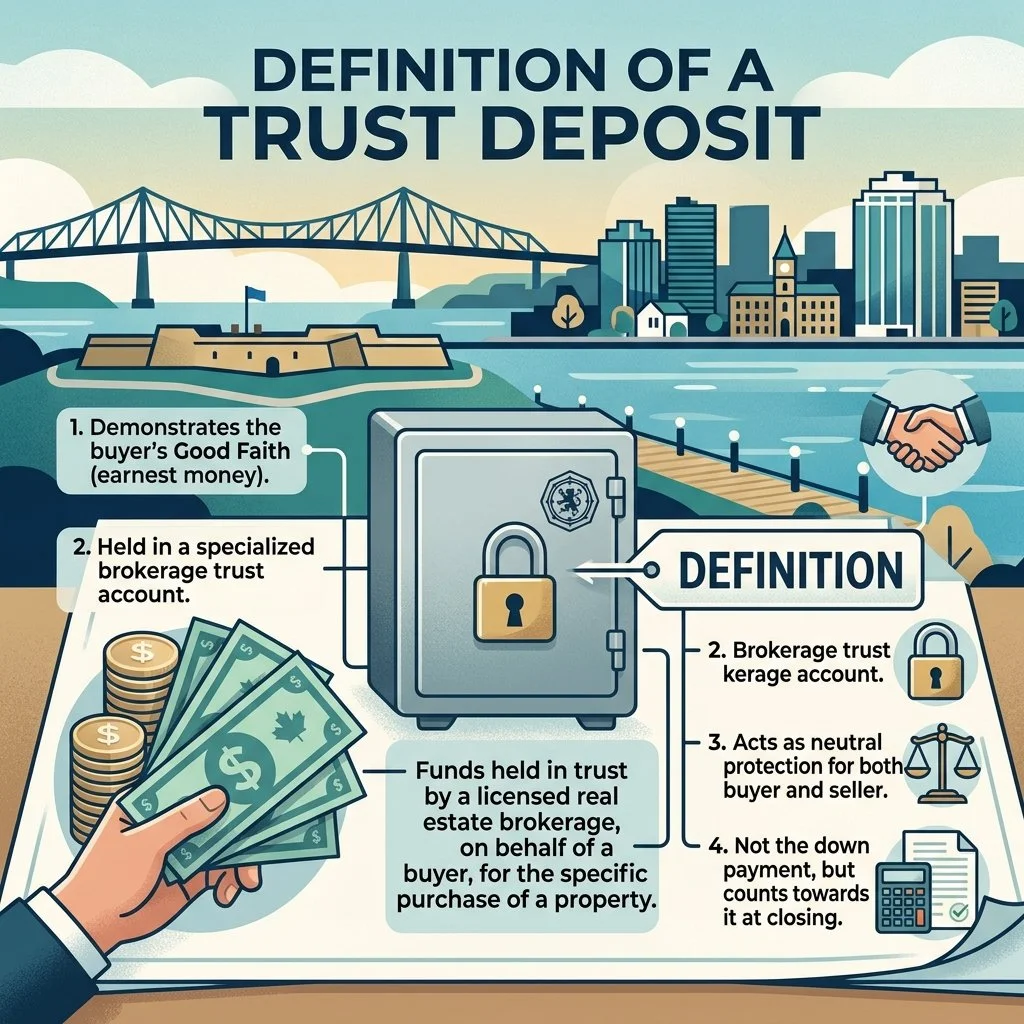
A clear visual breakdown defining what a real estate trust deposit is in Nova Scotia, explaining its role as earnest money held in a secure brokerage trust account.
Deposit vs. Down Payment: What’s the Difference?
It is common to confuse your trust deposit with your down payment, but they serve different timing and operational roles in Canadian real estate:
Trust Deposit (Paid First): Paid immediately upon offer acceptance to secure the contract. It sits in a trust account until closing day.
Down Payment (Paid at Closing): The total amount of equity you contribute toward the home's purchase price (typically 5% to 20% or more).
The Good News: Your trust deposit is not an extra cost. On closing day, the full deposit amount held in trust is credited toward your overall purchase price and counts directly toward your down payment or closing costs.
Example: If you are buying a $500,000 home in Halifax with a $25,000 (5%) total down payment requirement, and you paid a $5,000 trust deposit when your offer was accepted, you will only need to supply the remaining $20,000 at closing.
What Happens to Your Deposit if a Deal Fails?
One of the biggest anxieties for buyers is losing their deposit if something goes wrong. How your deposit is handled depends entirely on the terms of your Agreement of Purchase and Sale.
Scenario A: Terminating Under Conditions (Refundable)
If your agreement includes standard conditions—such as a satisfactory property inspection, water tests (for rural HRM homes), or formal mortgage approval—and you terminate within the condition period according to the contract, your deposit is returned to you in full without interest or penalty.
Scenario B: Buyer Breach (Forfeiture)
If all conditions are waived or satisfied (the deal goes "firm"), and you fail to complete the purchase without legal cause, you risk forfeiting your deposit to the seller. Additionally, the seller may sue for further damages if the property resells for a lower price.
The Mutual Release Requirement in Nova Scotia
Under NSREC By-law 611, a brokerage cannot simply hand money back to a buyer or seller because one party asks. Funds can only be released from a trust account if:
Both the buyer and seller sign a written Mutual Release agreement, OR
A court/adjudicator issues an official order instructing the broker on how to disburse the funds.
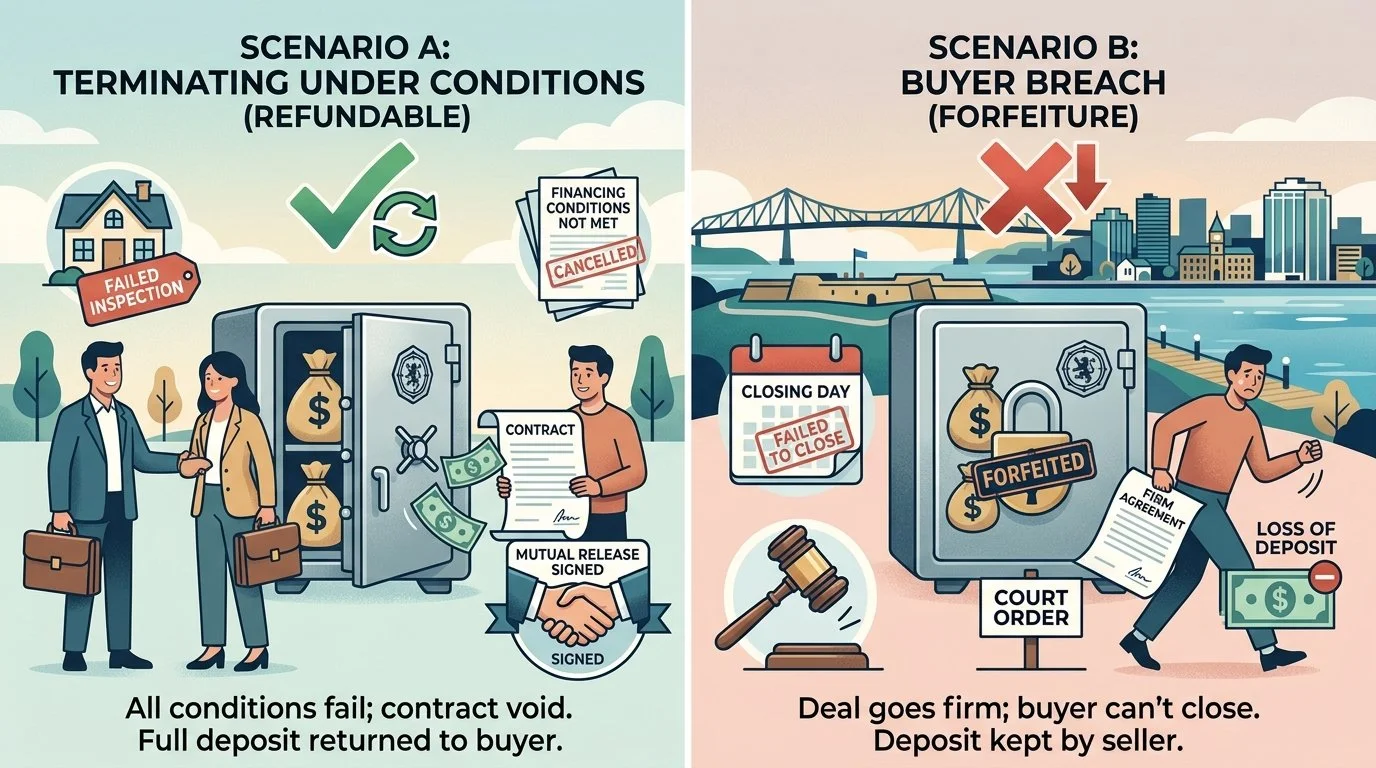
An informative infographic illustrating what happens to a real estate trust deposit in Nova Scotia during contract termination under conditions versus a buyer breach after a firm agreement.
Frequently Asked Questions (Q&A)
1. How much of a deposit should I offer when buying a home in Halifax?
While there is no legally mandated minimum deposit in Nova Scotia, custom in the HRM typically ranges from $1,000 to $10,000 depending on the price point. In competitive Halifax neighborhoods (like Downtown, Hydrostone, or Mount Royale), offering a higher deposit can make your offer look stronger to a seller without increasing your overall purchase price.
2. Can I pay my real estate deposit in cash or e-Transfer?
Most brokerages in Nova Scotia refrain from accepting physical cash for anti-money laundering and security reasons. Electronic transfers (e-Transfers or wire transfers) and bank drafts are widely accepted. Under NSREC regulations, e-Transfers are deemed received as soon as the receiving brokerage gets financial institution notification, provided it arrives on or before the contract deadline.
3. Does my real estate trust deposit earn interest while held in trust?
Generally, standard residential trust deposits in Nova Scotia are held in non-interest-bearing pooled trust accounts managed by the brokerage. Unless a specific clause is written into the Agreement of Purchase and Sale requiring funds to be placed in an interest-bearing account, the deposit is returned or credited without interest.
4. What happens if the seller refuses to sign a mutual release to return my deposit?
If a contract fails and the seller refuses to sign a mutual release, the brokerage must keep the funds frozen in the trust account. Neither party can access the money until the dispute is resolved. In these rare situations, the buyer or seller must apply to Small Claims Court or the Supreme Court of Nova Scotia to receive an adjudicator’s order directing the brokerage to release the deposit.
Ready to Make Your Move in Halifax?
Navigating real estate contracts, deposits, and closing requirements in Nova Scotia doesn't have to be overwhelming. Having local expertise on your side ensures your deposits are protected and your transactions run seamlessly from start to finish.
Looking to buy or sell property in the Halifax Regional Municipality?
Contact Me Today for a personalized consultation, or browse our latest Halifax property listings to start your journey!
