Decoding Halifax Property Taxes: Tax Rates by Area & How the CAP Works
Whether you are buying your first home on the Halifax Peninsula, moving to a family neighborhood in Bedford, or settling down on acreage in Musquodoboit Harbour, understanding Halifax property taxes is a crucial part of homeownership.
The Halifax Regional Municipality (HRM) covers a massive geographic footprint, over 5,400 square kilometers. Because service levels vary across this territory, HRM calculates property taxes based on distinct geographic service zones.
If you've ever wondered why your tax bill differs from a friend's across town or why your assessed home value doesn't match what you actually pay taxes on, this guide breaks down everything you need to know.
How Property Taxes Are Calculated in HRM
Your annual Halifax property tax bill is calculated using a straightforward formula:
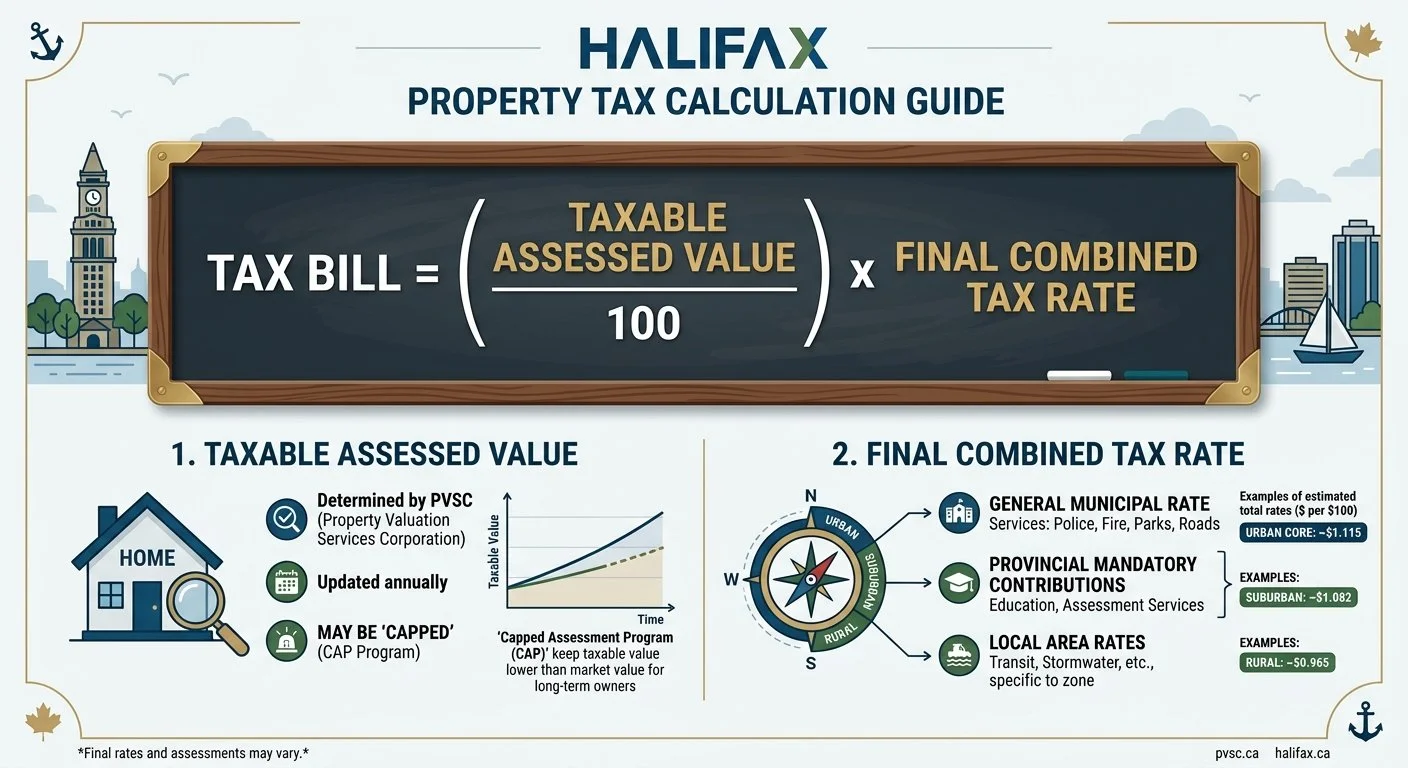
An infographic titled "Halifax Property Tax Calculation Guide" detailing the HRM tax formula: Tax Bill = (Taxable Assessed Value / 100) × Final Combined Tax Rate.
The Taxable Assessed Value is determined annually by the Property Valuation Services Corporation (PVSC), an independent organization that assesses every property across Nova Scotia.
Your total tax rate combines several layers:
General Municipal Rate: Base funding for municipal services (policing, fire, parks, road maintenance).
Provincial Mandatory Contributions: Fund allocation for education and assessment services.
Local Area Rates: Specific charges for services localized to your area, such as transit services, regional active transportation, stormwater management, or local business improvement districts.
Halifax Tax Rates by Area: Urban vs. Suburban vs. Rural
HRM divides property taxes into three primary regional service zones. Because core urban properties receive access to full municipal transit, central water/sewer connections, and dense street lighting, their base tax rates are higher than rural properties that rely on private wells and septic systems.
Here is how the rates break down across the municipality:
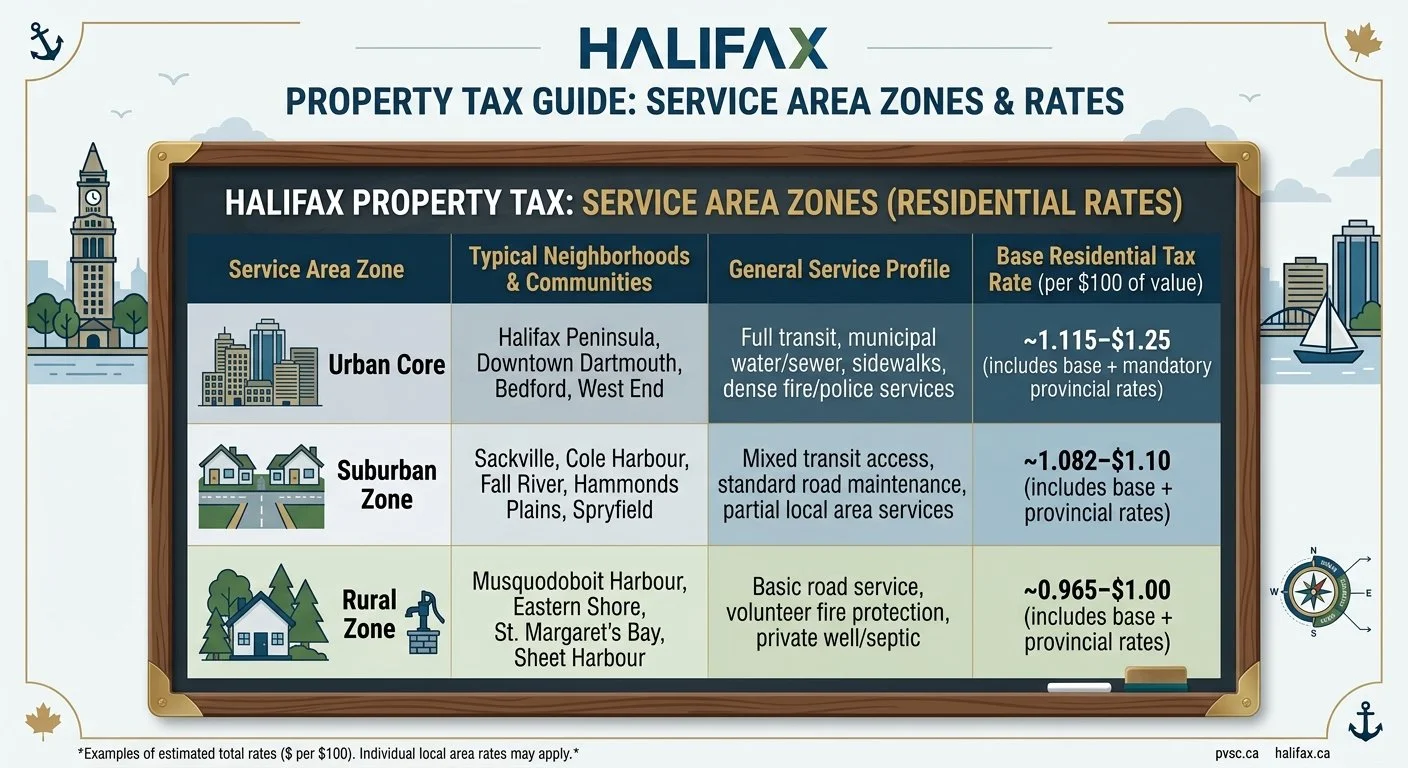
A clean reference table breaking down Halifax property tax rates by service area zone on a chalkboard graphic. It compares the Urban Core, Suburban Zone, and Rural Zone across typical neighborhoods (like Halifax Peninsula, Sackville, and Musquodoboit Harbour), general service profiles (such as transit, water, and fire services), and base residential tax rates ranging from ~$0.965 to ~$1.25 per $100 of value.
Note on Area Rates: Your final tax bill may include small additional line items (often adding $0.01 to $0.05 per $100 of value) for regional transit routes, climate action funds (HalifACT), or local active transportation projects.
Understanding Nova Scotia’s Capped Assessment Program (CAP)
One of the most confusing parts of property ownership in Nova Scotia is the difference between your Market Assessed Value and your Taxable Assessed Value. This difference exists because of the Capped Assessment Program (CAP).
What is the CAP?
Introduced by the Nova Scotia government, the CAP places an annual limit (cap) on how much a property’s taxable assessment value can increase year-over-year. The cap rate is tied to the Nova Scotia Consumer Price Index (CPI).
For example, even if property values in your Halifax neighborhood surge by 15% in a single year, your taxable assessment will only rise by the official CPI cap rate for that year.
Who Qualifies for the CAP?
To qualify for the capped assessment, a property must meet three criteria:
It must be at least 50% owned by a Nova Scotia resident.
It must be a residential property with less than four units.
The ownership must remain continuously held by the same owner (or family transfer).
The "CAP Reset" Trap for Home Buyers
If you are planning to buy a home in Halifax, this is the most critical detail to keep in mind: The CAP resets upon sale.
When a home changes ownership, the property is un-capped in the following tax year, and the taxable value jumps to match the full market assessed value.
If you buy a property that the previous owner held for 15 years, their property tax bill might be calculated on a capped value of $350,000. Once you buy it, your taxes will be calculated on the true market assessment (which could be $550,000+). Always calculate your expected property taxes based on the Assessed Market Value, not the seller's historic tax bill!
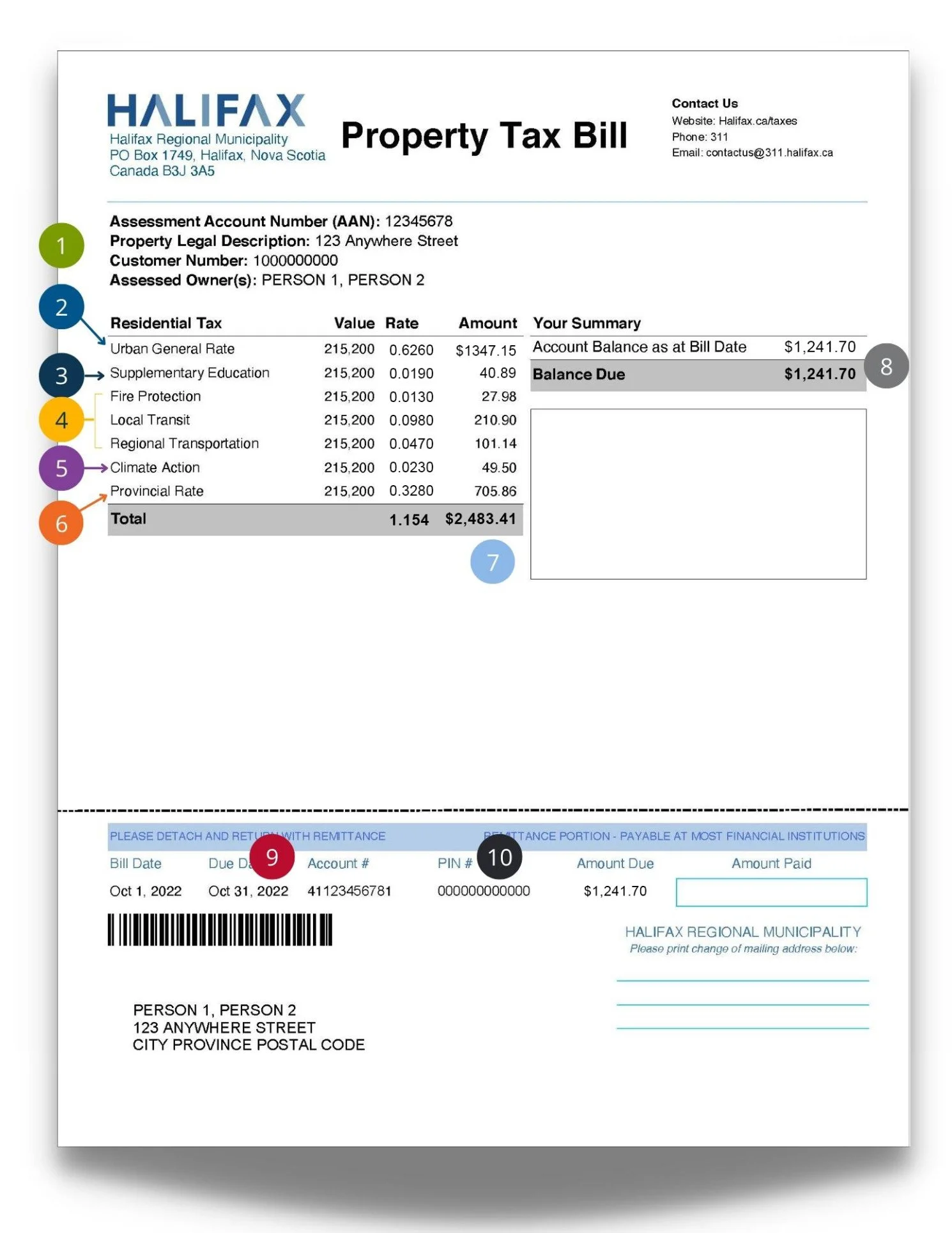
A sample Halifax Regional Municipality Property Tax Bill template featuring numbered callouts (1–10) explaining key sections. It breaks down residential tax line items—including the Urban General Rate, Supplementary Education, Fire Protection, Local Transit, Regional Transportation, Climate Action, and Provincial Rate—along with the taxable value, tax rates, total amount due, and bottom remittance stub.
Frequently Asked Questions (FAQ)
1. What is the difference between Market Assessed Value and Taxable Assessed Value in Halifax?
Your Market Assessed Value is PVSC’s estimate of what your property would have sold for on the open market as of the base date. Your Taxable Assessed Value is the actual dollar amount used to calculate your property tax bill. If your property is protected under the Capped Assessment Program (CAP), your Taxable Assessed Value will often be significantly lower than the Market Assessed Value.
2. How much will my property taxes increase when I buy a home in Halifax?
Because the CAP rate resets upon a change of ownership, your property taxes in your first full year of homeownership will be based on the property's full Market Assessed Value, not the previous owner's capped amount. If the seller owned the home for many years, your annual tax bill could increase by anywhere from a few hundred to several thousand dollars compared to what the seller was paying.
3. When are Halifax property tax bills due?
HRM issues property tax bills twice per year:
Interim Bill: Issued in March and due on the last business day of April (calculated as roughly 50% of the previous year’s taxes).
Final Bill: Issued in September and due on the last business day of October (reflects current tax rates minus your interim payment).
4. Can I appeal my property assessment if I think it is too high?
Yes. When PVSC mails out assessment notices every January, property owners have 31 days from the date on the notice to file an official appeal. You can submit evidence such as comparable local home sales or structural issue documentation to request a review of your market valuation.
Navigating Halifax Real Estate with Confidence
Understanding how property taxes and CAP adjustments affect your bottom line is essential whether you're buying, selling, or investing in Halifax Regional Municipality. Don't let tax surprises catch you off guard after closing day.
Planning a move or looking for an accurate tax estimate on a local home?
Contact Me Today to get expert local real estate advice tailored to your goals. We'll help you calculate true ownership costs so you can make confident decisions every step of the way.
