What to Do Before Buying a House in Halifax: Defining Your Wants vs. Needs
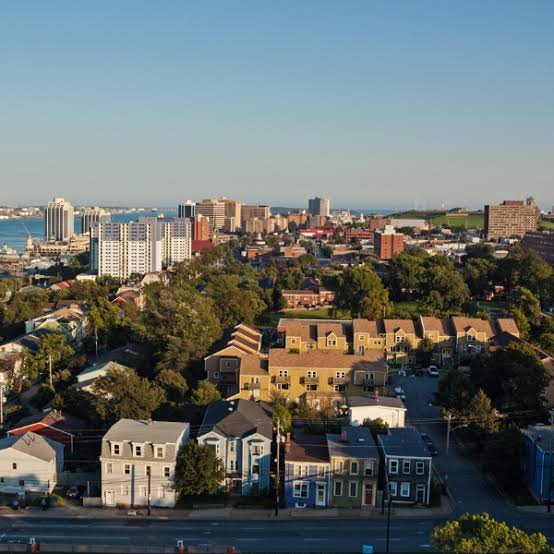
An elevated aerial photograph displaying the Halifax Peninsula urban and residential landscape. The image captures a mix of multi-story apartment buildings, historic homes, and detached residences nestled among lush green trees, with the Halifax Harbour and city skyline visible under a clear blue sky.
Getting pre-approved for a mortgage is a major milestone, but jumping straight onto Realtor.ca and booking viewings for every staged home in the Halifax Regional Municipality (HRM) is a frequent mistake for first-time buyers.
Without a defined strategy, buyers risk falling in love with aesthetic upgrades while overlooking critical structural, geographic, and financial dealbreakers. Before stepping foot inside a property in Halifax, Dartmouth, Bedford, or Lower Sackville, establishing a framework to separate non-negotiable Needs from secondary Wants is essential for long-term satisfaction and financial security.
1. The "Tuesday Test": Defining Everyday Priorities
When evaluating a prospective home, base decisions on realistic daily routines rather than sunny weekend open houses.
A property must function seamlessly during a dark, rainy Tuesday commute in November. Consider key lifestyle factors:
Commute Routes: Crossing the Angus L. Macdonald or A. Murray MacKay Bridges during rush hour significantly impacts travel times between Dartmouth and the Halifax Peninsula.
Parking & Snow Removal: On-street parking in Halifax's South End or North End presents distinct winter challenges due to seasonal municipal parking bans compared to properties with dedicated paved driveways in suburban HRM.
Functional Layout: Adequate bedrooms for remote work, storage capacity, or layout accessibility directly influence long-term usability.
2. Halifax-Specific Wants vs. Needs Factors
Buying real estate in Nova Scotia involves regional infrastructure considerations that differ from other North American housing markets:
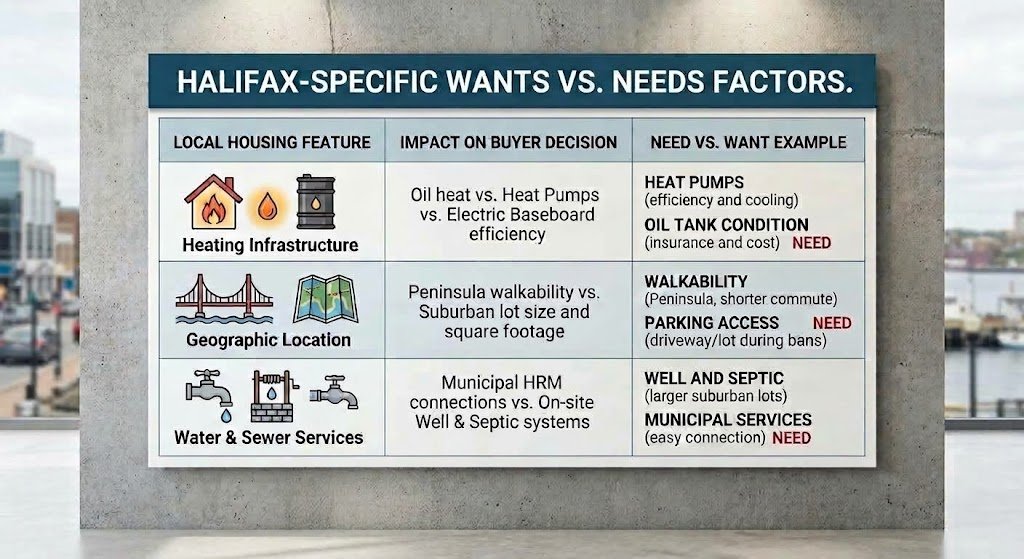
A structured visual infographic titled "Halifax-Specific Wants vs. Needs Factors." The chart is divided into three rows covering core Nova Scotia real estate considerations.
Heating Systems & Utility Bills
Heat source directly impacts monthly carrying costs and property insurance eligibility:
Oil Forced Air / Hot Water: Requires monitoring oil delivery, tank age, and compliance tags. Many home insurance providers require replacement for steel oil tanks over 10 to 15 years old.
Ductless / Ducted Heat Pumps: Provide efficient winter heating and essential summer cooling. Installing heat pumps after purchase can be a high-priority "Want," but existing systems add immediate equity and comfort.
Electric Baseboard: Offers lower initial equipment risk, but monthly utility costs vary significantly during Atlantic winter months depending on home insulation levels.
Peninsula Living vs. Commuter Communities
Budget allocation in HRM requires choosing between proximity and spatial footprint:
Halifax Peninsula / Downtown Dartmouth: Command higher price-per-square-foot ratios, offering walkability, transit access, and historic character at the trade-off of smaller lot sizes and older building stock.
Suburban HRM (Bedford, Lower Sackville, Cole Harbour, Timberlea): Provide larger lots, modern building systems, multi-car parking, and additional square footage at the expense of a longer daily commute.
3. Financial Preparation Beyond the Down Payment
Before touring homes, buyers must ensure liquid capital is set aside for non-negotiable Nova Scotia closing costs. These funds are required in addition to the down payment:
Halifax Deed Transfer Tax (DTT): Calculated at 1.5% of the total purchase price within the Halifax Regional Municipality. On a $500,000 purchase, the DTT equals $7,500 due on closing.
Legal Fees & Disbursements: Typically range between $1,500 and $2,500 for property title searches, deed registration, and closing management.
Home Inspection: Professional property inspections generally cost between $500 and $800 depending on home size and auxiliary testing (e.g., well water or radon testing).
Utility & Fuel Adjustments: Reimbursements owed to the seller for pre-filled oil tanks or prepaid property taxes at closing.

A wide-angle street-level photo of the pedestrian-friendly Argyle Street entertainment district in downtown Halifax. The image highlights patio dining areas, local pubs, brick architecture, string lights, and city foot traffic during late afternoon.
4. Frequently Asked Questions (Halifax Home Buying Q&A)
What is the deed transfer tax rate in Halifax?
The Halifax Regional Municipality (HRM) charges a Deed Transfer Tax of 1.5% of the home's purchase price. This tax is payable at closing by the buyer through their real estate lawyer.
Should I avoid buying a home in Halifax with an oil tank?
Not necessarily, but due diligence is required. Insurance companies in Nova Scotia maintain strict regulations regarding oil heating systems. Buyers should verify the tank's installation date, construction material (granite/steel vs. fiberglass), and double-bottom safety status during the inspection period.
Is it better to buy on the Halifax Peninsula or in the suburbs?
Choosing between the Peninsula and suburban HRM depends on personal lifestyle priorities. Peninsula homes offer high walkability and shorter commute times but generally feature smaller lots and older infrastructure. Suburbs like Bedford, Sackville, and Cole Harbour offer newer builds and larger spaces for similar budgets.
How much extra cash do I need for closing costs in Nova Scotia?
It is recommended to budget 1.5% to 2% of the home's purchase price exclusively for closing costs in Nova Scotia, which covers the municipal deed transfer tax, legal fees, home inspection costs, and property tax adjustments.
Start Your Halifax House Search with Confidence
Navigating the Halifax real estate market requires clear criteria and local market knowledge. Having a structured strategy ensures you make informed decisions when visiting prospective properties.
Ready to get started? Click here and book a free, no-obligation 30 minute phone call with me.
