
Historic sandstone facade of Nova Scotia Province House in downtown Halifax, home to the provincial legislature overriding local municipal housing policies.
Nova Scotia just executed a complete power move over Halifax, and it is going to fundamentally transform the neighborhood you live in.
The provincial government issued sweeping, mandatory amendments to the Halifax Regional Municipality (HRM) Charter. These regulations force city hall to scrap key municipal zoning and design restrictions to accelerate homebuilding across the region.
Why does this matter to you? Whether you are a buyer trying to find an affordable home, a homeowner worried about mid-rise apartment blocks built next door, or a commuter facing increased traffic on suburban roads, these rules directly touch your property values, daily transit, and local services. Is this the bold red-tape cutting Halifax needs, or is the province opening a Pandora's box of long-term urban planning chaos? Let us break down the details.
What Actually Changed in the HRM Planning Directives?
To understand the debate at City Hall, we have to look at what the province actually ordered HRM to do under the Minimum Planning Requirement Regulations. The province mandated four core structural shifts:
Overnight Accommodations to Apartments: Properties zoned for hotels, long-term care facilities, or overnight accommodations must automatically permit residential apartment developments of a similar scale.
Mass Timber Acceleration: The municipality must remove design barriers that impede constructing mass timber residential structures up to 12 storeys high.
Removing Conservation Limits: Restrictions that limit eligible conservation-design developments based on construction start dates or lot creation dates are scrapped.
Subdivisions and Emergency Egress: HRM must update planning documents to permit new housing subdivisions in areas where creating public streets improves street connectivity and emergency egress for existing communities.
The timeline is tight. City Hall is required to adopt key zoning changes by January 15, 2027, and finish aligning its regional planning documents by June 30, 2027.
The Pros: Why Cutting Red Tape Matters for Halifax
Housing supply across Nova Scotia is extremely tight, and provincial leaders argue that traditional municipal approvals take too long.
Halifax Mayor Andy Fillmore welcomed the provincial push, noting the importance of eliminating bureaucratic steps that stall residential construction. From a builder's perspective, standardized rules remove months of back-and-forth over minor design items.
Mass timber offers a clear example. Mass timber is fast to erect, lower-carbon, and highly sustainable. Standardizing 12-storey approvals helps developers use modern modular construction without hitting custom municipal setback rules.
Similarly, allowing residential conversions on commercial hotel properties makes sense on paper. If a site already supports a multi-storey hotel with continuous traffic and utility usage, converting that space into permanent rental apartments puts land to good use without requiring new raw territory.
The Cons: Infrastructure Strain and the Pandora's Box Warning
While developers and provincial leaders focus on speed, local councillors and environmental groups express deep concern. They view the mandate as top-down overreach that bypasses local democratic planning.
Halifax Councillor Kathryn Morse warned that overriding established municipal plans opens a Pandora's box of unintended consequences. Representatives from environmental groups like the Ecology Action Centre stress that growth works best when kept inside HRM's urban service boundary, where water, sewer, transit, and fire protection already exist.
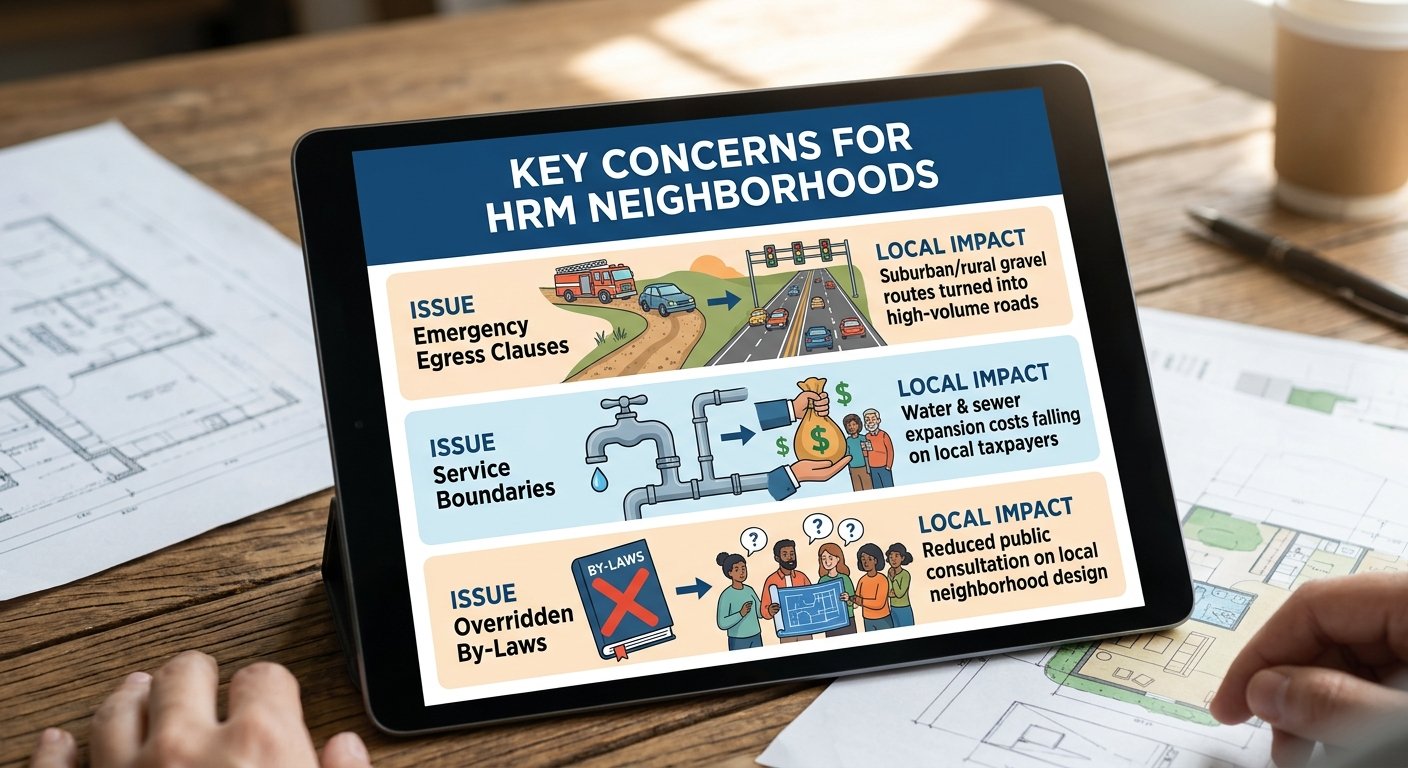
Visual breakdown of how Nova Scotia's new housing directives impact HRM neighborhoods, property taxes, traffic routes, and local urban planning.
Consider the emergency egress clause. Subdivisions can now be enabled if connecting streets improve emergency routes. Councillor Morse highlighted that many secondary routes in outlying HRM communities are narrow, unpaved gravel tracks meant strictly for emergency vehicles. Opening these corridors to full residential subdivisions risks putting daily traffic on roads never designed for high capacity.
Who Pays for the Underground Infrastructure?
Houses require more than wood and concrete. They need water mains, wastewater treatment, stormwater management, transit lines, and local schools.
City planners set zoning limits to balance building scale against utility capacities. When provincial mandates override local growth plans, municipal staff are left to solve the logistical and financial problems. If a series of new residential units goes up along a rural access point, upgrading those roads, extending water mains, and adding transit routes costs millions of dollars. That financial burden lands squarely on local property tax accounts.
The Verdict: Balanced Urgency or Unchecked Risk?
Both sides bring valid arguments to the table, but the province is running a high-stakes play.
The housing shortage in Halifax demands urgency. Streamlining approvals for mass timber and allowing hotel-to-apartment conversions are practical ways to add units fast. The province is correct to push back against needless delays.
However, overriding local planning without providing direct, matched funding for municipal infrastructure is risky. Speed loses its value if it creates severe traffic choke points, strains water systems, and leaves new communities without basic services. For this strategy to succeed long-term, the province must back up its housing mandates with dedicated infrastructure funding for HRM.
Frequently Asked Questions
What are the main housing changes Nova Scotia is forcing on Halifax?
The province is mandating that HRM permit mass timber residential buildings up to 12 storeys, allow automatic apartment conversions in hotel zones, remove conservation-design timeline limits, and enable new subdivisions along emergency access routes.
When do these new zoning rules take effect in HRM?
The provincial timeline requires Halifax Regional Municipality to adopt core zoning changes by January 15, 2027, and complete all regional planning updates by June 30, 2027.
How do these planning changes affect current Halifax homeowners?
Homeowners may see higher density built nearby in commercial zones, increased construction activity, and potential shifts in local traffic patterns, particularly near secondary access roads.
Why are Halifax councillors concerned about emergency egress rules?
Councillors worry that using narrow, unpaved emergency routes to unlock new housing developments will overload rural and suburban infrastructure that was never designed for everyday traffic volumes.

Halifax Mayor Andy Fillmore, now will work with the province on the new housing directives, discussing regional planning and municipal housing policy at a Halifax Chamber of Commerce event.
Join the Conversation
How do you feel about Nova Scotia overriding Halifax zoning rules? Will these changes solve our housing shortage, or will they strain local services in your neighborhood?
Leave a comment below with your thoughts. If you want ongoing analysis of Halifax real estate, municipal planning updates, and local housing policy, subscribe to my YouTube Channel today.
