View of the Bank of Canada headquarters building in Ottawa, Ontario. Showing the prominent stone-carved sign for Canada's central bank.
The Halifax Regional Municipality (HRM) real estate market has experienced dynamic shifts over recent years. From the urban core of the Peninsula and Dartmouth to fast-growing suburban communities like Bedford, Sackville, and Cole Harbour, housing demand in Nova Scotia remains historically high.
However, local buyers and homeowners alike are closely watching economic indicators. With fixed mortgage rates already inching upward in bond markets and the upcoming Bank of Canada rate decision on October 28, 2026, many are wondering: How will potential rate increases affect home values and borrowing power across Halifax?
Here is an analysis of where mortgage rates stand, what a rate increase means for your monthly bottom line, and how these shifts could influence buyers and sellers across HRM.
Fixed Mortgage Rates Have Already Increased
While headline news often focuses on variable-rate policy announcements, fixed mortgage rates move independently based on 5-year Government of Canada bond yields.
Over recent weeks, bond yields have trended higher, leading major Canadian lenders to raise fixed mortgage rates ahead of central bank decisions. For buyers holding a pre-approval, this means the fixed rates available today may be higher than those quoted earlier in the season.
Rising fixed rates affect buyer behavior in two immediate ways:
Reduced Maximum Purchase Price: Higher interest rates reduce the total mortgage amount a lender will approve under the federal mortgage stress test.
Urgency Among Pre-Approved Buyers: Buyers holding rate-holds are often motivated to make offers before their lower fixed rate expires.
The Math: How a 0.25% Rate Hike Impacts a $500,000 Mortgage
To understand the real-world impact of a interest rate increase, let's break down the math on a typical home purchase in Halifax, where average single-family home prices often hover around $500,000.
Assuming a $500,000 mortgage balance amortized over 25 years:
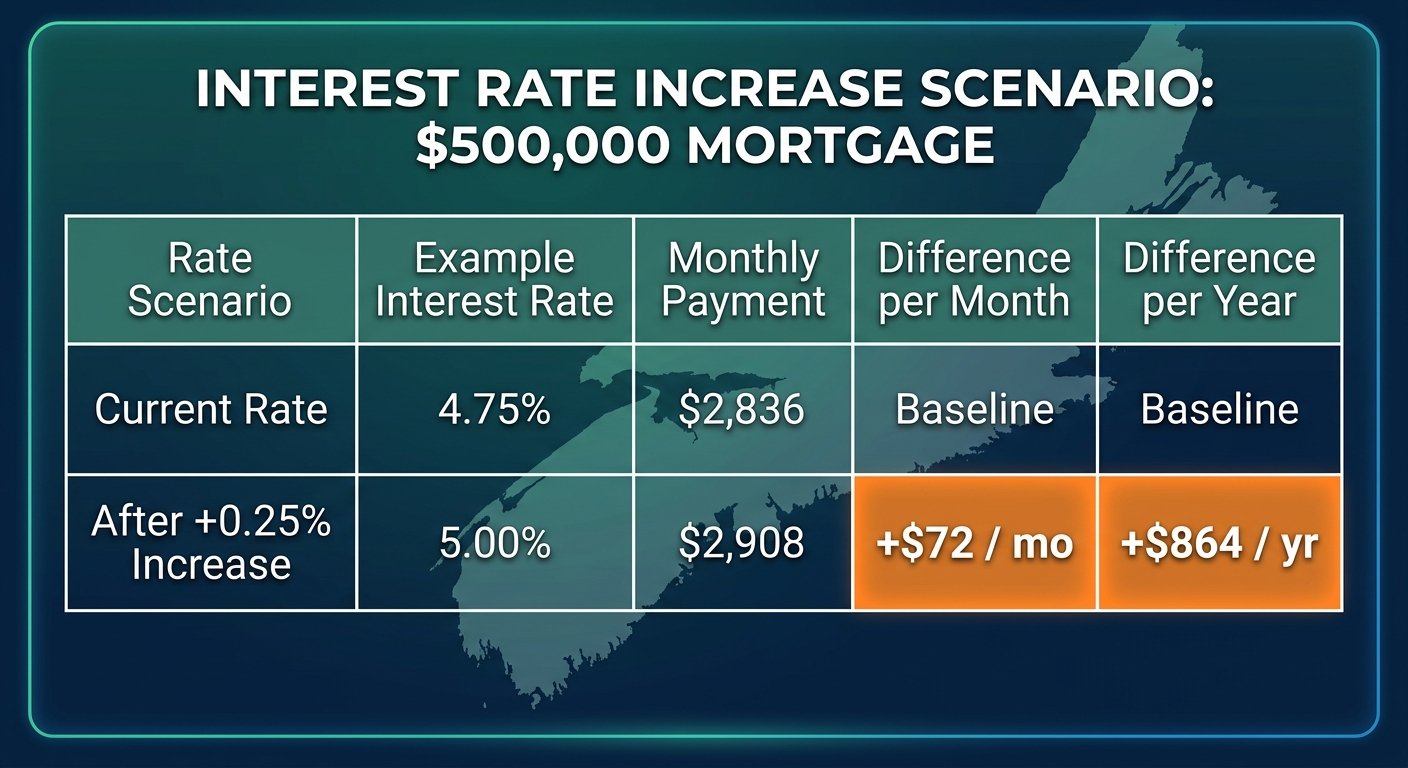
A 0.25% interest rate hike adds $72 per month and $864 per year to a $500,000 mortgage payment. This infographic details the precise cost difference for Nova Scotia homeowners.
Key Takeaway for Buyers
A 0.25% (25 basis points) increase adds approximately $72 per month (or $864 per year) to a $500,000 mortgage payment.
A 0.50% increase adds approximately $146 per month (or $1,752 per year).
While a $72 monthly change may seem manageable on its own, cumulative increases erode overall purchasing power—forcing some buyers to lower their target purchase price or search in surrounding suburban neighborhoods.
What Rising Rates Mean for the Halifax Market
For Buyers in HRM
Stress Test Pressure: All prospective buyers must pass the federal mortgage stress test (qualifying at their contract rate plus 2%, or 5.25%, whichever is higher). As contract rates rise, qualifying becomes stricter.
Shift in Property Types: Higher borrowing costs frequently shift buyer demand from detached single-family homes toward semi-detached homes, townhouses, and condos in areas like Spryfield, Lower Sackville, or Dartmouth.
For Sellers in HRM
Balanced Market Conditions: While Halifax continues to face a structural housing supply shortage driven by population growth, higher interest rates moderate runaway bidding wars. Homes that are priced accurately and staged well still sell, but offer conditional periods and inspection clauses have returned to normal transactions.
Pricing Strategy Matters: Overpricing in a rising-rate environment increases days on market. Correct strategy upfront is critical to securing strong offers.
Frequently Asked Questions (Q&A)
1. How does the Bank of Canada policy rate affect my mortgage in Halifax?
The Bank of Canada’s policy rate directly sets the Prime Rate used by commercial banks. If the central bank increases its rate, variable-rate mortgages and Home Equity Lines of Credit (HELOCs) increase immediately. Fixed-rate mortgages do not change mid-term, but new fixed rates are influenced by government bond market yields.
2. Should I choose a fixed or variable mortgage rate right now in Nova Scotia?
Choosing between a fixed and variable rate depends on your personal risk tolerance and budget flexibility. Fixed rates offer payment predictability over a 3- to 5-year term, which is ideal if your household budget is tight. Variable rates may offer potential savings if rates decrease later in your term, but they expose you to immediate payment increases if rates rise. Speak with a licensed Nova Scotia mortgage broker to model both scenarios.
3. Will rising interest rates cause Halifax home prices to crash?
While higher interest rates moderate buyer purchasing power, a price crash in Halifax is unlikely due to strong underlying market fundamentals. High net migration to Nova Scotia, sustained population growth across HRM, and a persistent shortage of inventory continue to support overall property values. Instead of a sharp decline, rate hikes typically result in slower price growth and a more balanced market.
4. What should I do if my Halifax home mortgage renewal is coming up this year?
If your mortgage is up for renewal in the next 6 to 12 months, start exploring your options early. Most lenders allow you to lock in a renewal rate up to 120 days in advance without penalty. Shopping around between different lenders or working with a mortgage broker can help you secure the best rate before potential future hikes take effect.
Ready to Navigate the Halifax Housing Market?
Whether you are buying your first home in Dartmouth, upgrading in Bedford, or preparing to list your property on the Halifax Peninsula, navigating interest rate fluctuations requires expert local strategy.
Contact our team today for a custom market evaluation or to discuss your home-buying plan in the Halifax Regional Municipality.
