
A visual representation of bridge financing showing how a short-term loan bridges the financial gap between funding and purchasing a home in Nova Scotia
Navigating the real estate market in the Halifax Regional Municipality (HRM) often requires speed and precision. Whether you are upgrading to a suburban family home in Bedford, downsizing to a condo in Downtown Halifax, or buying along the South Shore, you may find yourself in a common situation: your new purchase closes before the sale of your current home.
When closing dates fail to line up, you face a temporary financial shortfall for your down payment and closing costs. This is where bridge financing (also known as a bridge loan) comes in.
Here is everything Nova Scotia homeowners need to know about how bridge loans work, qualification rules, associated fees, and how to protect yourself during a real estate transition.
What is Bridge Financing?
Bridge financing is a short-term, temporary loan designed to "bridge" the financial gap between the purchase of your new property and the legal closing of your current property.
It allows you to extract equity from your existing home before you physically receive the funds on its closing day. Your lender advances the equity needed for your new down payment, allowing your Nova Scotia real estate lawyer to close on your new property seamlessly.
How Bridge Loans Work in Nova Scotia
Bridge financing in Nova Scotia is governed by standard Canadian lending rules, but it requires coordination with your local real estate lawyer and mortgage professional.
Key Qualification Rules
A "Firm" Agreement of Purchase and Sale is Mandatory: Major Canadian lenders (such as RBC, TD, Scotiabank, or local credit unions) will not approve open-ended bridge loans on a property that is merely listed or conditionally sold. You must have an unconditional, firm contract on both your current property (selling) and your new property (buying).
Matching Lenders: In almost all cases, the lender providing your new mortgage must also provide your bridge loan.
Time Limits: Typical bridge loan terms in Nova Scotia range from 1 to 90 days, though some lenders will extend up to 120 days in specific situations.
Equity Thresholds: You can generally borrow up to the net equity of your sold home, however, many lenders are capped at 80% of it’s appraised value minus your existing mortgage balance.
Calculating Your Bridge Financing Net Equity
To determine how much you can borrow, lenders evaluate your Net Sale Equity:
Net Equity = Sale Price - (Existing Mortgage Payout + Real Estate Commission + Legal Fees)
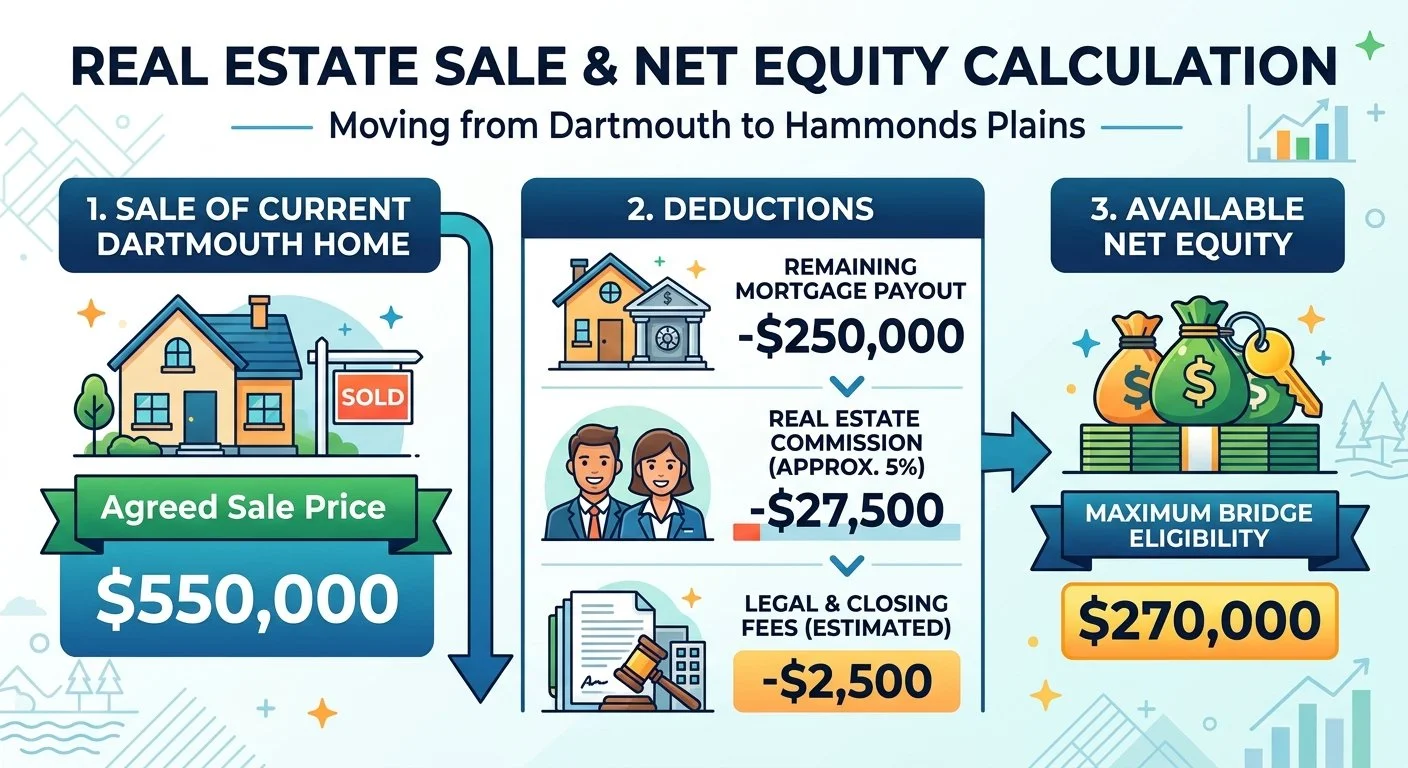
If your new purchase in Hammonds Plains requires a $150,000 down payment on June 1st, but your Dartmouth sale closes on June 15th, your lender bridges the $150,000 gap for those 14 days.
Breakdown of Bridge Loan Costs in Nova Scotia
Bridge financing is convenient, but it comes at a cost. However, because the loan term is usually short (often a few days or weeks), the overall dollar amount remains relatively small.
Interest Rates: Interest rates on bridge loans are typically higher than prime mortgage rates—usually Prime + 2% to Prime + 3%. Interest accrues daily on the borrowed amount.
Lender Administration Fees: Lenders usually charge a flat administrative fee ranging between $200 and $500 to set up the bridge loan.
Legal Fees: Your Nova Scotia property lawyer handles the legal coordination, undertaking to pay off the bridge loan directly from your sale proceeds when the old home closes. Lawyers typically charge a small additional administrative fee for processing bridge documentation.
Strategic Benefits for Halifax Buyers
Avoid Moving Twice: A bridge loan allows you to obtain the keys to your new home early. This gives you time to paint, renovate, or move belongings from your old place in Halifax without staying in temporary housing.
Competitive Edge in Hot Neighbourhoods: In fast-moving areas like North End Halifax or Lower Sackville, sellers prefer firm offers with clean closing dates. Bridge financing ensures you do not have to make your purchase offer conditional on the closing date of your current home.

A professional consultation with a mortgage broker helping Halifax buyers secure home financing options.
Frequently Asked Questions (FAQ)
What happens if the buyer of my home delays closing?
If your buyer requests an extension on the closing date, your lawyer and mortgage broker must inform your lender immediately to extend the bridge loan term. As long as the contract remains legally firm, most lenders will accommodate a short extension, though additional daily interest will apply.
Can I get bridge financing in Nova Scotia without a firm sale?
Standard bank bridge loans require a firm, unconditional sale agreement. If your current home is not yet sold, you cannot secure a traditional bridge loan. In these cases, you may need to look at alternative solutions such as a Home Equity Line of Credit (HELOC) or private short-term financing.
How do property taxes and Deed Transfer Tax factor in?
In Nova Scotia, the buyer pays the Municipal Deed Transfer Tax (MDTT)—which is 1.5% of the purchase price in the Halifax Regional Municipality—upon closing. Because a bridge loan only covers your down payment gap from sale proceeds, ensure you factor the MDTT, legal fees, and adjustments into your total cash required on your purchase closing day.
Is bridge financing automatically included with my new mortgage?
No. Bridge financing is a separate credit facility that must be explicitly underwritten and approved alongside your new home loan. Always advise your mortgage broker or lender as early as possible if your purchase and sale closing dates do not match.
Plan Your Move with Confidence
Timing your real estate transaction in Halifax doesn't have to be stressful. Whether you are navigating overlapping closing dates, calculating your net sale proceeds, or looking for the best mortgage options in Nova Scotia, professional guidance ensures a smooth move.
Ready to explore your financing options? Contact me today to review your purchase timeline and secure a tailored mortgage solution for your next Halifax home.
